
Fall 2024- Student Edition
“Unlimited, Together we’re unlimited… I’m flying high, Defying gravity. And soon I’ll match them in renown, And nobody in all of Oz, No Wizard that there is or was, Is ever gonna bring me down!”
– Elphaba from Wicked
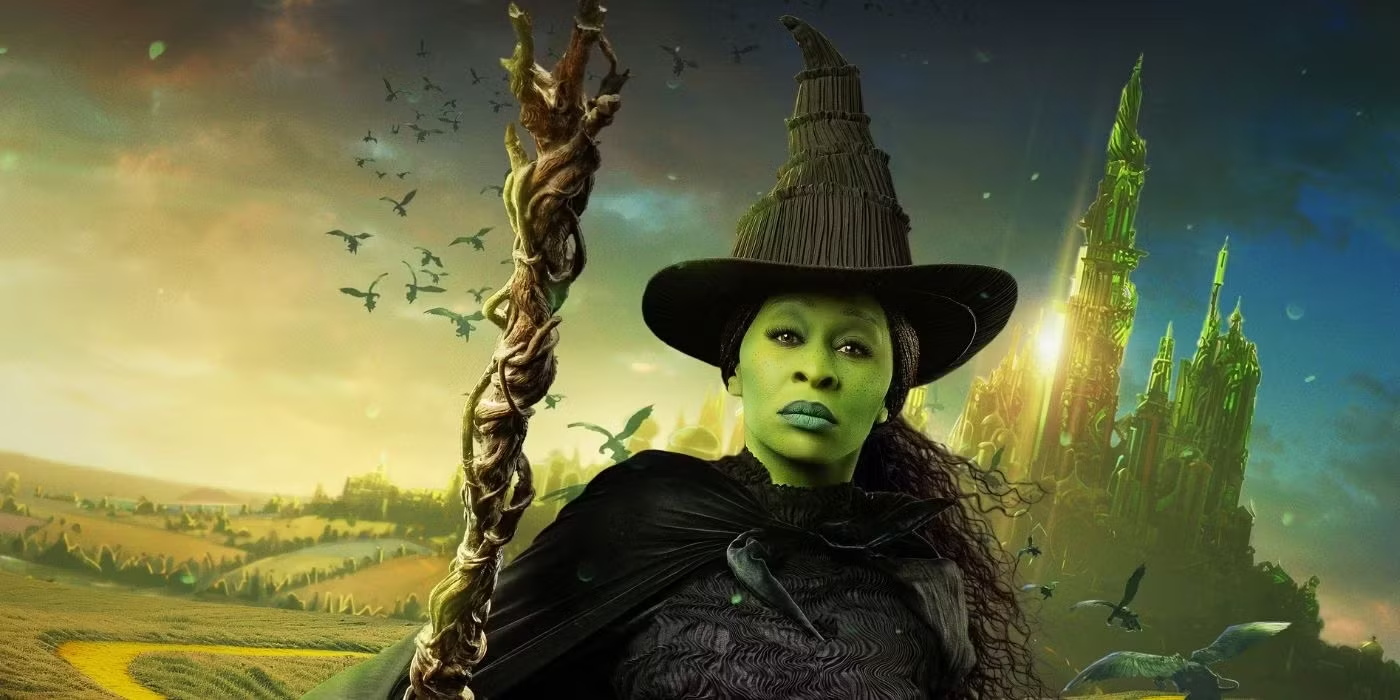
Let Wicked Radicalize You!
An In-Depth Analysis of Wicked as an Allegory of Societal Sleepwalking into Fascism
The dawn of November 6, 2024, marked a moment of despair etched into my memory. At 3 a.m., I awoke restless, only to see the news that Donald Trump had been re-elected. A wave of fear swept over me, bringing back the anxiety of his first term as an undocumented DACA recipient and queer man. That evening, a 73-year-old queer elder confided in me, recalling the despair of the AIDS epidemic in the 1980s, when a president ignored the suffering of his community. His words were a stark reminder of the cyclical nature of oppression and the resilience required to endure it.
Amid this darkness, Jon M. Chu’s 2024 film adaptation of Wicked offered unexpected solace. Long a source of joy and empowerment, Wicked resonated deeply in this political moment. The story of Elphaba Thropp, falsely labeled “wicked,” unfolded as an allegory for resistance against systemic oppression. Through its exploration of authoritarianism, marginalization, and intersectionality, the film became a manifesto for awakening social consciousness and dismantling oppressive systems.
Elphaba embodies intersectionality, a term Kimberlé Crenshaw coined to describe overlapping systems of oppression. Her green skin marks her as “other,” ostracizing her from birth. Gloria Anzaldúa’s concept of the borderlands—existing between identities—further illuminates Elphaba’s struggle as a woman who disrupts binaries of good and wicked. Her rejection of the Wizard’s regime, which scapegoats talking Animals to consolidate power, mirrors real-world authoritarian tactics. Just as Trump vilified immigrants and transgender individuals to justify oppressive policies, the Wizard weaponizes fear and propaganda to sustain his authority.
Cynthia Erivo’s casting as Elphaba adds profound depth. A queer Black woman, Erivo embodies the intersecting identities that Crenshaw describes, enriching Elphaba’s narrative with lived experiences of marginalization. Elphaba’s defiance aligns with Chela Sandoval’s Methodology of the Oppressed, as she moves from institutional reform to revolutionary resistance, adapting her strategies to confront systemic forces.
The film critiques performative allyship through Glinda’s arc. Initially complicit in the Wizard’s regime, Glinda’s transformation critiques the hollow gestures of privilege—akin to corporate diversity initiatives that prioritize optics over meaningful change. Her journey reflects Dr. Bettina Love’s concept of coconspiratorship: the shift from passive support to active disruption of oppressive systems. Glinda’s eventual reckoning invites us to embrace substantive solidarity over symbolic gestures, committing to justice even when it demands sacrifice.
Wicked also addresses speciesism, using the plight of talking Animals as an allegory for systemic exploitation. Elphaba’s advocacy reflects Lori Gruen’s concept of “entangled empathy,” an ethical framework that calls for recognizing interconnected oppressions. By challenging speciesism, the film urges us to extend liberation to non-human beings through cruelty-free practices and plant-based diets, aligning our actions with a broader vision of justice.
The Wizard’s rise to power, built on propaganda and fear, mirrors fascist tactics. State-controlled media in countries like Russia and Venezuela and platforms like Fox News in the U.S. perpetuate disinformation, normalizing oppression. Dr. Renée Lemus’s transformative critical media literacy framework emphasizes the importance of questioning these narratives to ignite resistance.
As Brené Brown reminds us, “Hope is not an emotion; it’s a cognitive-behavioral process.” Watching Wicked became my act of micro-dosing hope, a reminder that resistance begins with small, deliberate actions. Elphaba’s refusal to conform and Glinda’s eventual courage illustrate the power of community and solidarity. Together, they remind us that we, too, can rise above despair and defy gravity. In a world riddled with systemic injustice, Wicked is more than a story—it is a call to action. Together, we are unlimited.

Featured Posts

Echoes from East LA: Martha Gonzalez’s Journey Through Music, Activism, and Artivism
Javier Santillan Martha Gonzalez is an accomplished artist, activist, and scholar known for her significant contributions to the East Los Angeles 90s music and art scene. A member of the Grammy-winning band Quetzal, Gonzalez’s work extends beyond music into community…


The Intersection of Witchcraft and Catholicism in Chicana/o Spirituality
The intersection of witchcraft and Catholic beliefs among Chicana/o people can, beyond any doubt, be perceived as cultural and spiritual resistance to colonial and patriarchal powers colonizing native Indigenous populations. For Chicana women, this blending of Indigenous culture with Catholicism…


Lowriding: A Chicana Community
Chicanas have played a crucial role within the Chicana/o community as they have been present for every milestone that has shaped the history of Chicana/os in a positive way. As throughout history there has been many testimonios of strong Chicanas…


Deconstructing The Master’s Tools
Title: Deconstructing the Master’s Tools: Chicana Feminism Resisting Settler Colonialism Abstract:This paper explores the intersection of settler colonialism and Chicana feminism with a critical framework for understanding the enduring impacts of settler colonialism on Indigenous and Mexican-Americans in the United…


Nada Mas Que Decir (Nothing Left To Say)
Queridx Juanito, So many words left unsaid, So Many Memories, So Many Dreams, So Many Laughs. I never told you how much your strength carried me through and what your sisterhood meant to me during our time in ICE Detention.…


