Historically, female anatomy has often been represented as taboo, shameful, and hypersexualized. These ideas have carried throughout history where female anatomy was treated as inferior to the anatomy of their male counterparts due to the lack of understanding and knowledge as to how their bodies function. For most of history, the female body was seen as an object of reproduction or property. According to an online article by Time, “Knowledge about female biology centered on women’s capacity—and duty—to reproduce…women’s illnesses and diseases consistently related to the ‘secrets’ and ‘curiosities’ of her reproductive organs” (Cleghorn, The Long History of Gender Bias in Medicine). As long as a woman was able to reproduce they were deemed as healthy. This mindset led many doctors to ignore any other medical symptoms a woman might have and led to the idea that women just had hysteria. Being historically misunderstood has led to a sense of mystery and confusion about the female body. This confusion has carried throughout history and has influenced how female health is roughly taught today. Education about the female body can be deemed as uncomfortable or inappropriate leaving generation after generation of women uninformed and unprepared. Although medicine has since expanded and evolved, there is still a lack of general understanding and education about basic female anatomy and its inner workings which has led to negative consequences.
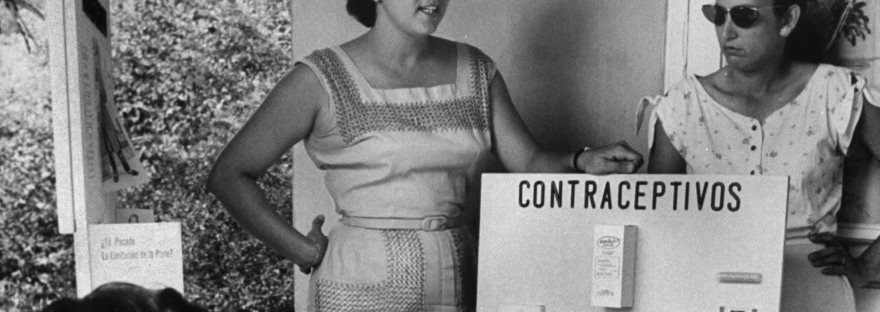
The lack of education about the female body not only causes confusion and discomfort among both males and females but has led to detrimental consequences. Not being informed about one's reproductive anatomy can be harmful as it can lead women to become more vulnerable to medical manipulation, misinformation, and control. This control has led to forced medical procedures, lack of informed consent, and administration of unknown medications. In the chapter titled Better Dead Than Pregnant, Smith explains how reproductive rights, specifically those of Indigenous women have been weaponized against them as a form of control. She further explains how young women from marginalized communities can be manipulated due to underlying factors of medical racism that make it easier for doctors to administer nonconsensual procedures. In one case “ ..the woman had been given a complete hysterectomy for birth control purposes when she was 20 years old and had not been informed that the operation was irreversible” (Smith 81). This lack of communication between doctors and patients is a form of power and control over their bodies. Without adequate education on the topic, most women are left with knowledge gaps and shame about their bodily autonomy. In some cases, this lack of knowledge has resulted in health complications. In an article titled The Birth Control Pill, Thromboembolic Disease, Science and the Media: A Historical Review of the Relationship, Lackie states that “Thromboembolic disease includes blood clots and pulmonary embolism. Scientific reports suggesting a possible relationship between the Pill and thromboembolic risk made headlines in the worlds of women's health care, policy and media” (Lackie 17). She explains that although rare, birth control pills can slightly increase one's risk of health complications. This further highlights the dangers of inadequate information when dealing with the female reproductive system